# visualizeR  > What a color! What a viz!
`visualizeR` proposes some utils to sane colors, ready-to-go color
palettes, and a few visualization functions.
## Installation
You can install the last version of visualizeR from
[GitHub](https://github.com/) with:
``` r
# install.packages("devtools")
devtools::install_github("gnoblet/visualizeR", build_vignettes = TRUE)
```
## Roadmap
Roadmap is as follows: - \[ \] Full revamp \## Request
Please, do not hesitate to pull request any new viz or colors or color
palettes, or to email request any change ().
## Colors
Functions to access colors and palettes are `color()` or `palette()`.
Feel free to pull request new colors.
``` r
library(visualizeR)
# Get all saved colors, named
color(unname = F)[1:10]
#> white lighter_grey light_grey dark_grey black
#> "#FFFFFF" "#F5F5F5" "#E3E3E3" "#464647" "#000000"
#> cat_2_yellow_1 cat_2_yellow_2 cat_2_light_1 cat_2_light_2 cat_2_green_1
#> "#ffc20a" "#0c7bdc" "#fefe62" "#d35fb7" "#1aff1a"
# Extract a color palette as hexadecimal codes and reversed
palette(palette = "cat_5_main", reversed = TRUE, color_ramp_palette = FALSE)
#> [1] "#083d77" "#4ecdc4" "#f4c095" "#b47eb3" "#ffd5ff"
# Get all color palettes names
palette(show_palettes = TRUE)
#> [1] "cat_2_yellow" "cat_2_light"
#> [3] "cat_2_green" "cat_2_blue"
#> [5] "cat_5_main" "cat_5_ibm"
#> [7] "cat_3_aquamarine" "cat_3_tol_high_contrast"
#> [9] "cat_8_tol_adapted" "cat_3_custom_1"
#> [11] "cat_4_custom_1" "cat_5_custom_1"
#> [13] "cat_6_custom_1" "div_5_orange_blue"
#> [15] "div_5_green_purple"
```
## Charts
### Example 1: Bar chart
``` r
library(palmerpenguins)
library(dplyr)
df <- penguins |>
group_by(island, species) |>
summarize(
mean_bl = mean(bill_length_mm, na.rm = T),
mean_fl = mean(flipper_length_mm, na.rm = T)
) |>
ungroup()
df_island <- penguins |>
group_by(island) |>
summarize(
mean_bl = mean(bill_length_mm, na.rm = T),
mean_fl = mean(flipper_length_mm, na.rm = T)
) |>
ungroup()
# Simple bar chart by group with some alpha transparency
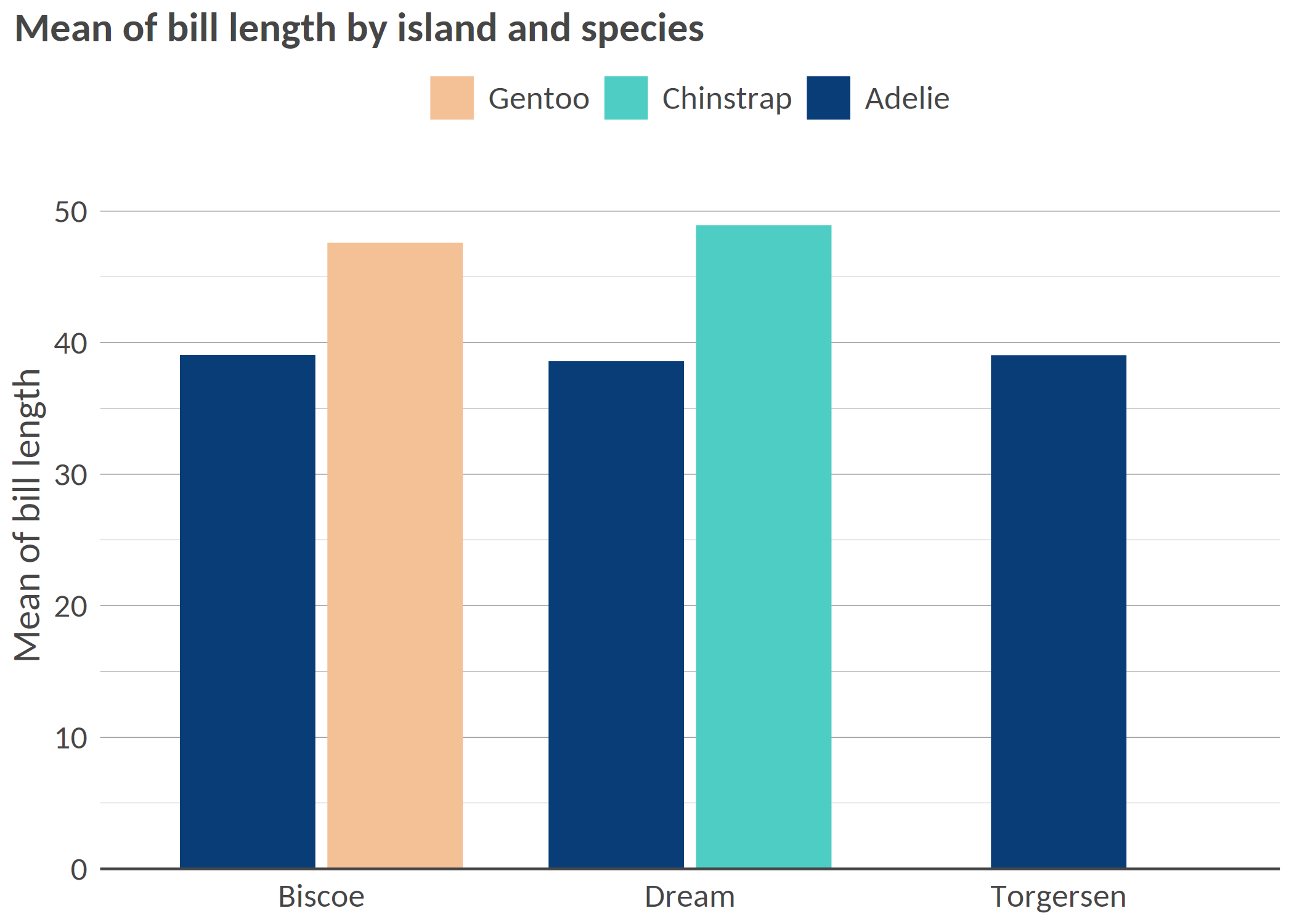
bar(df, "island", "mean_bl", "species", x_title = "Mean of bill length", title = "Mean of bill length by island and species")
```
> What a color! What a viz!
`visualizeR` proposes some utils to sane colors, ready-to-go color
palettes, and a few visualization functions.
## Installation
You can install the last version of visualizeR from
[GitHub](https://github.com/) with:
``` r
# install.packages("devtools")
devtools::install_github("gnoblet/visualizeR", build_vignettes = TRUE)
```
## Roadmap
Roadmap is as follows: - \[ \] Full revamp \## Request
Please, do not hesitate to pull request any new viz or colors or color
palettes, or to email request any change ().
## Colors
Functions to access colors and palettes are `color()` or `palette()`.
Feel free to pull request new colors.
``` r
library(visualizeR)
# Get all saved colors, named
color(unname = F)[1:10]
#> white lighter_grey light_grey dark_grey black
#> "#FFFFFF" "#F5F5F5" "#E3E3E3" "#464647" "#000000"
#> cat_2_yellow_1 cat_2_yellow_2 cat_2_light_1 cat_2_light_2 cat_2_green_1
#> "#ffc20a" "#0c7bdc" "#fefe62" "#d35fb7" "#1aff1a"
# Extract a color palette as hexadecimal codes and reversed
palette(palette = "cat_5_main", reversed = TRUE, color_ramp_palette = FALSE)
#> [1] "#083d77" "#4ecdc4" "#f4c095" "#b47eb3" "#ffd5ff"
# Get all color palettes names
palette(show_palettes = TRUE)
#> [1] "cat_2_yellow" "cat_2_light"
#> [3] "cat_2_green" "cat_2_blue"
#> [5] "cat_5_main" "cat_5_ibm"
#> [7] "cat_3_aquamarine" "cat_3_tol_high_contrast"
#> [9] "cat_8_tol_adapted" "cat_3_custom_1"
#> [11] "cat_4_custom_1" "cat_5_custom_1"
#> [13] "cat_6_custom_1" "div_5_orange_blue"
#> [15] "div_5_green_purple"
```
## Charts
### Example 1: Bar chart
``` r
library(palmerpenguins)
library(dplyr)
df <- penguins |>
group_by(island, species) |>
summarize(
mean_bl = mean(bill_length_mm, na.rm = T),
mean_fl = mean(flipper_length_mm, na.rm = T)
) |>
ungroup()
df_island <- penguins |>
group_by(island) |>
summarize(
mean_bl = mean(bill_length_mm, na.rm = T),
mean_fl = mean(flipper_length_mm, na.rm = T)
) |>
ungroup()
# Simple bar chart by group with some alpha transparency
bar(df, "island", "mean_bl", "species", x_title = "Mean of bill length", title = "Mean of bill length by island and species")
```
 ``` r
# Flipped / Horizontal
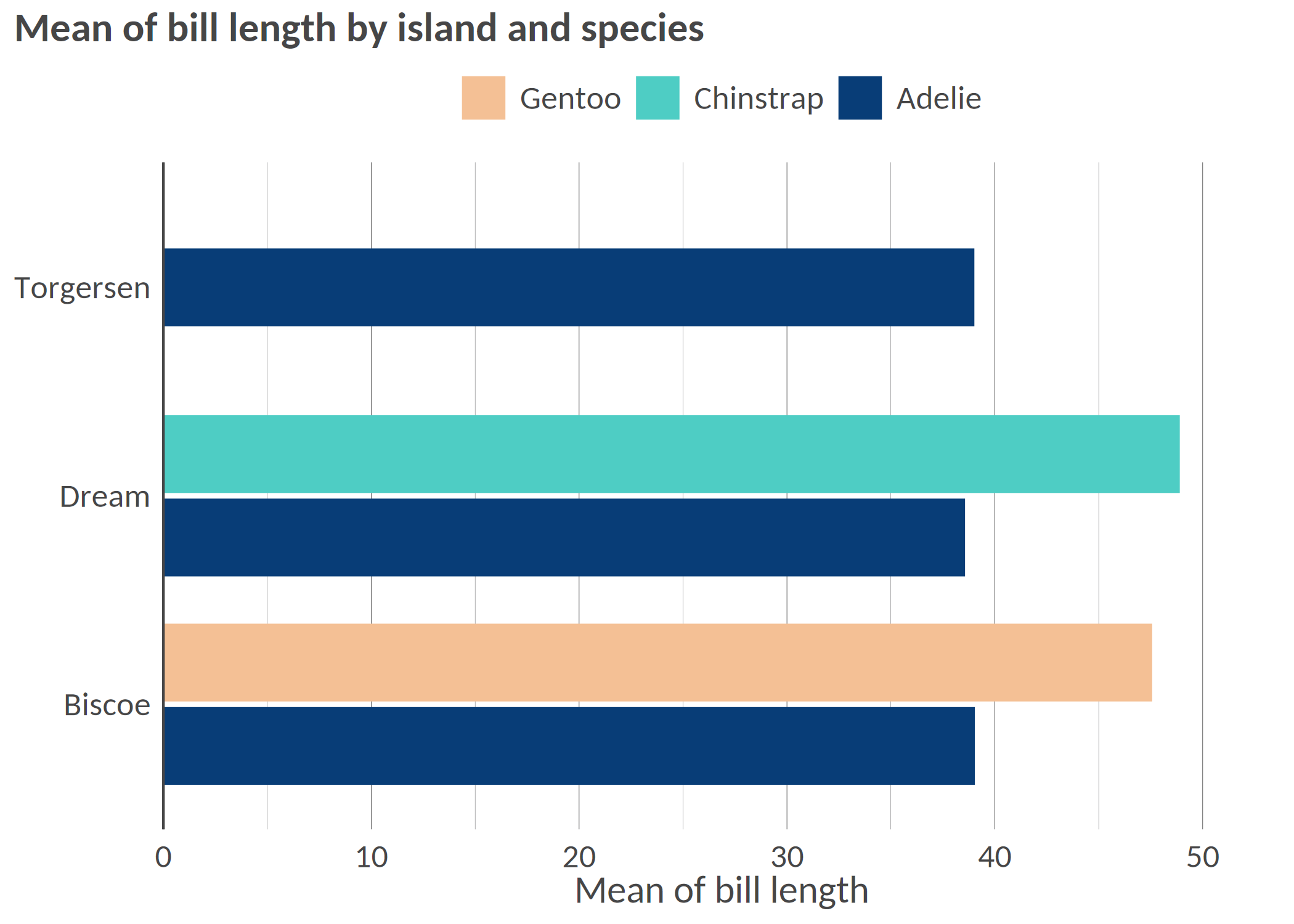
hbar(df, "island", "mean_bl", "species", x_title = "Mean of bill length", title = "Mean of bill length by island and species")
```
``` r
# Flipped / Horizontal
hbar(df, "island", "mean_bl", "species", x_title = "Mean of bill length", title = "Mean of bill length by island and species")
```
 ``` r
# Facetted
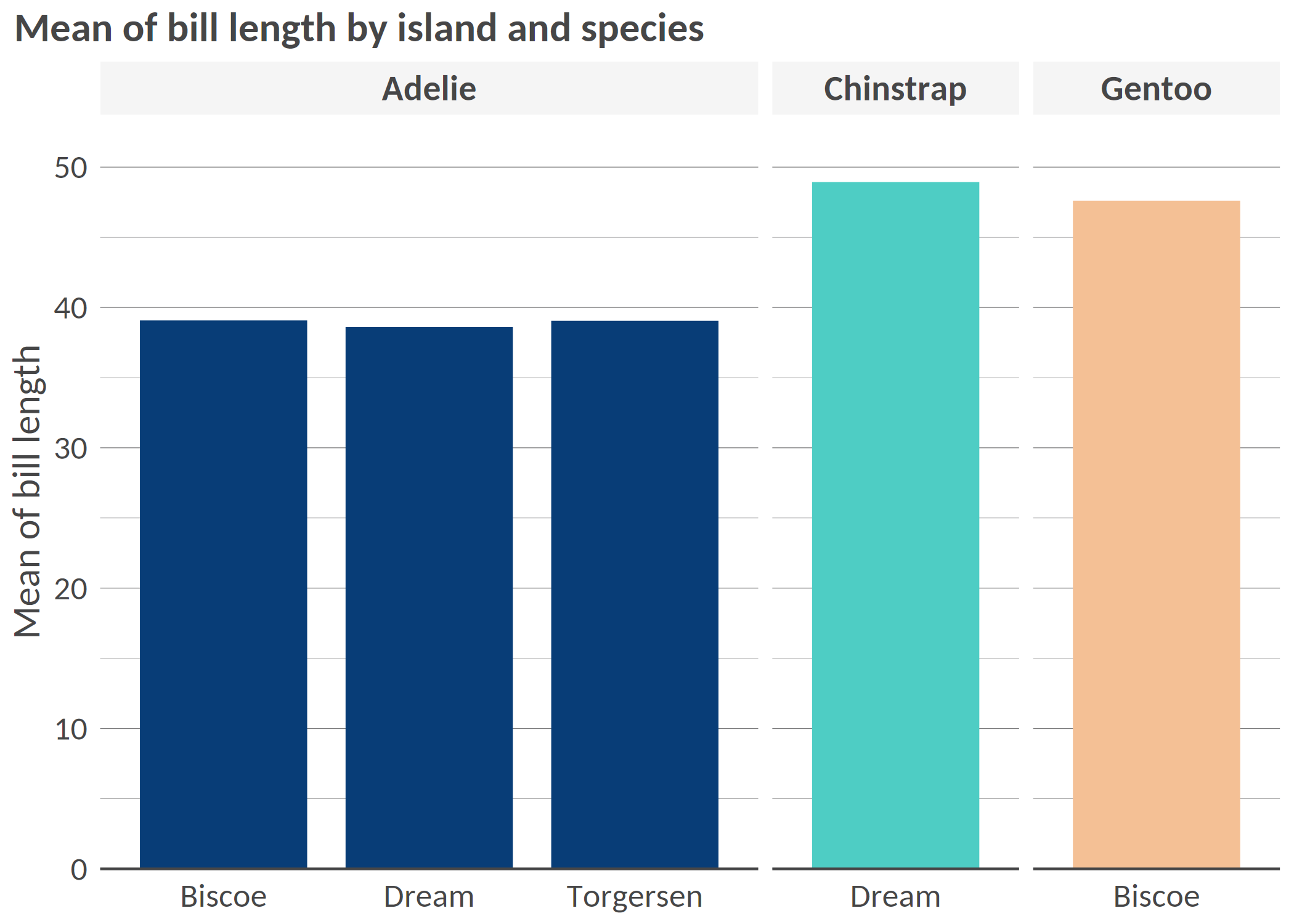
bar(df, "island", "mean_bl", "species", facet = "species", x_title = "Mean of bill length", title = "Mean of bill length by island and species", add_color_guide = FALSE)
```
``` r
# Facetted
bar(df, "island", "mean_bl", "species", facet = "species", x_title = "Mean of bill length", title = "Mean of bill length by island and species", add_color_guide = FALSE)
```
 ``` r
# Flipped, with text, smaller width
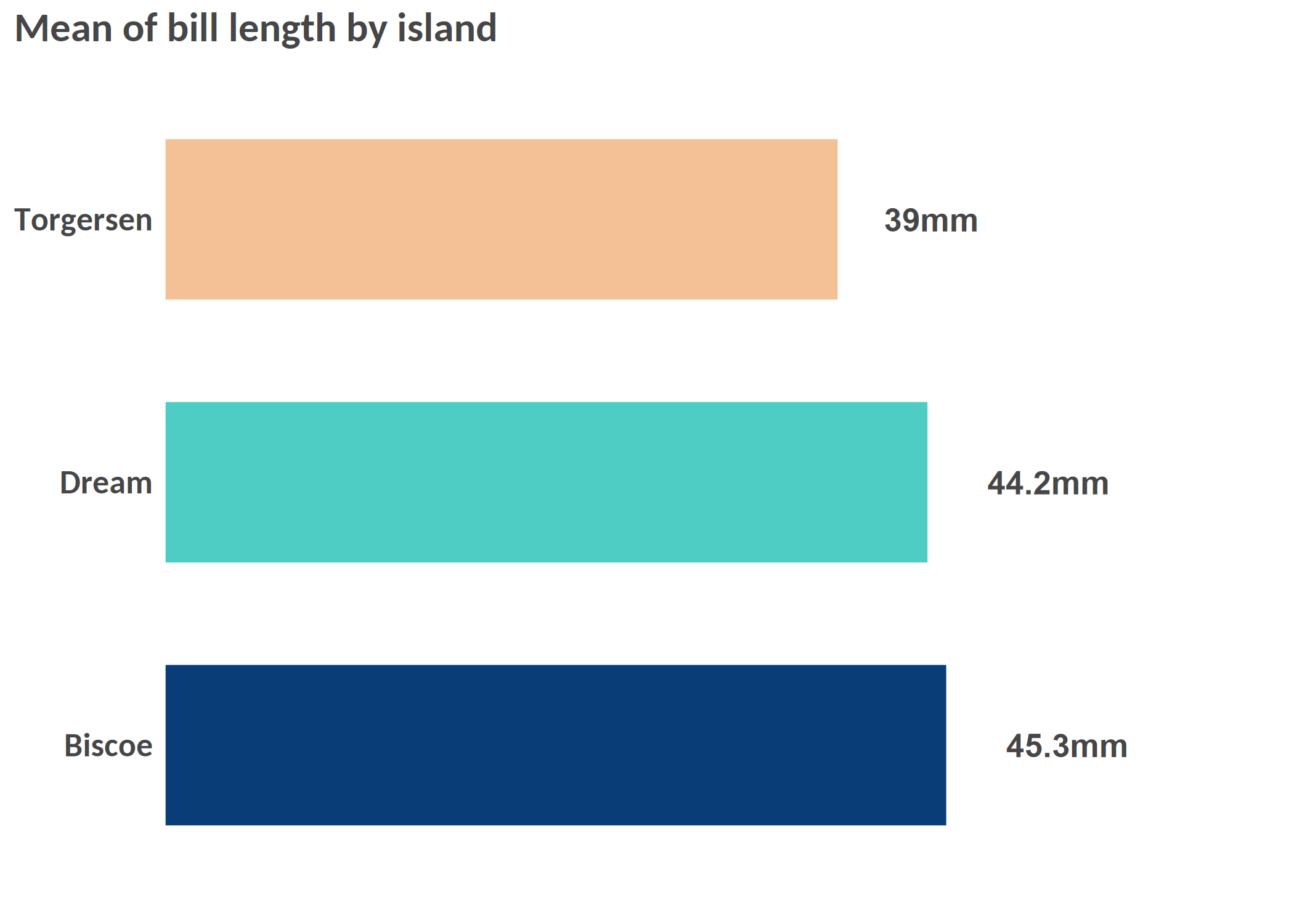
hbar(df = df_island, x = "island", y = "mean_bl", group = "island", title = "Mean of bill length by island", add_text = T, width = 0.6, add_text_suffix = "mm", add_text_expand_limit = 1.3, add_color_guide = FALSE)
```
``` r
# Flipped, with text, smaller width
hbar(df = df_island, x = "island", y = "mean_bl", group = "island", title = "Mean of bill length by island", add_text = T, width = 0.6, add_text_suffix = "mm", add_text_expand_limit = 1.3, add_color_guide = FALSE)
```
 ### Example 2: Scatterplot
``` r
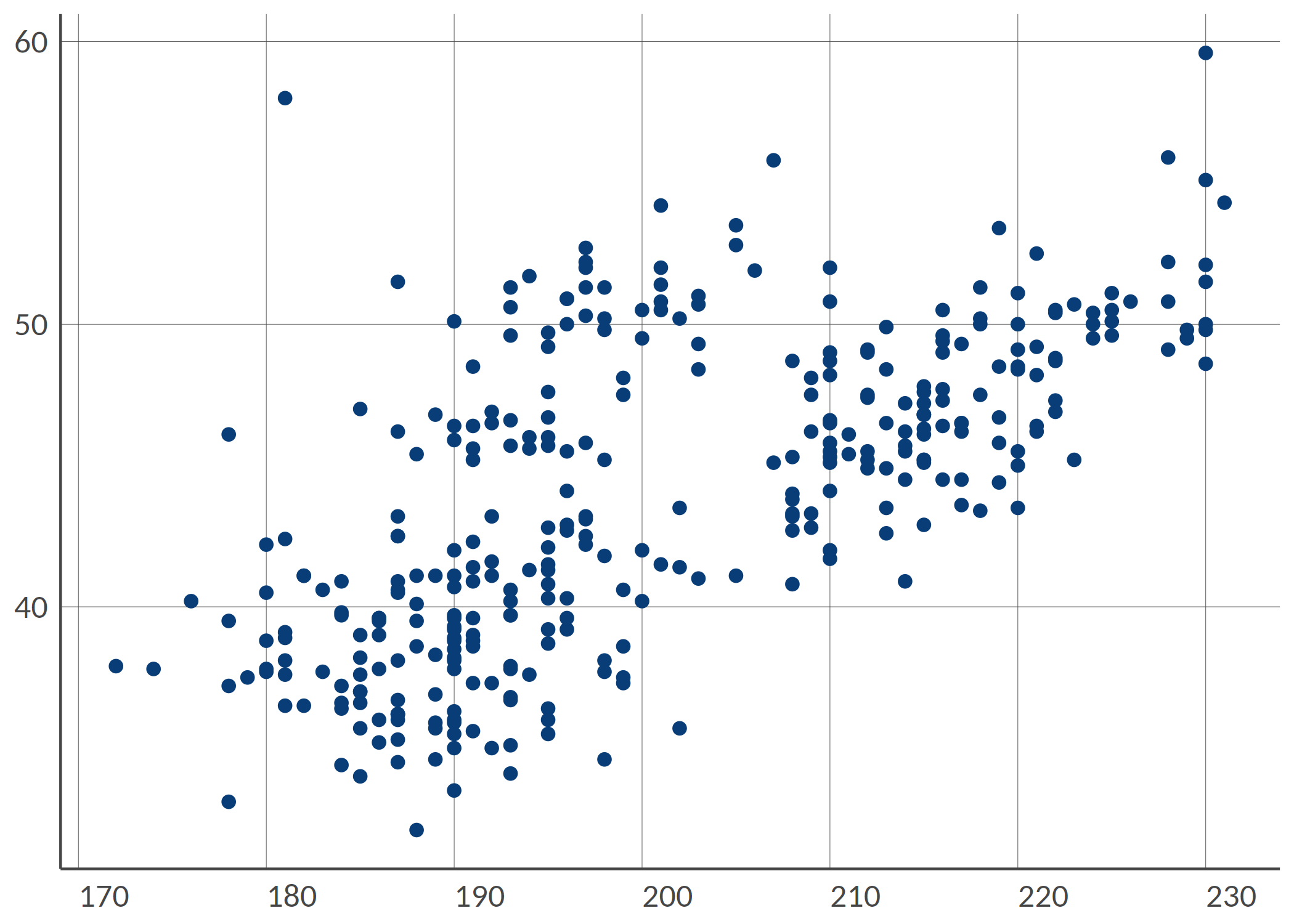
# Simple scatterplot
point(penguins, "bill_length_mm", "flipper_length_mm")
```
### Example 2: Scatterplot
``` r
# Simple scatterplot
point(penguins, "bill_length_mm", "flipper_length_mm")
```
 ``` r
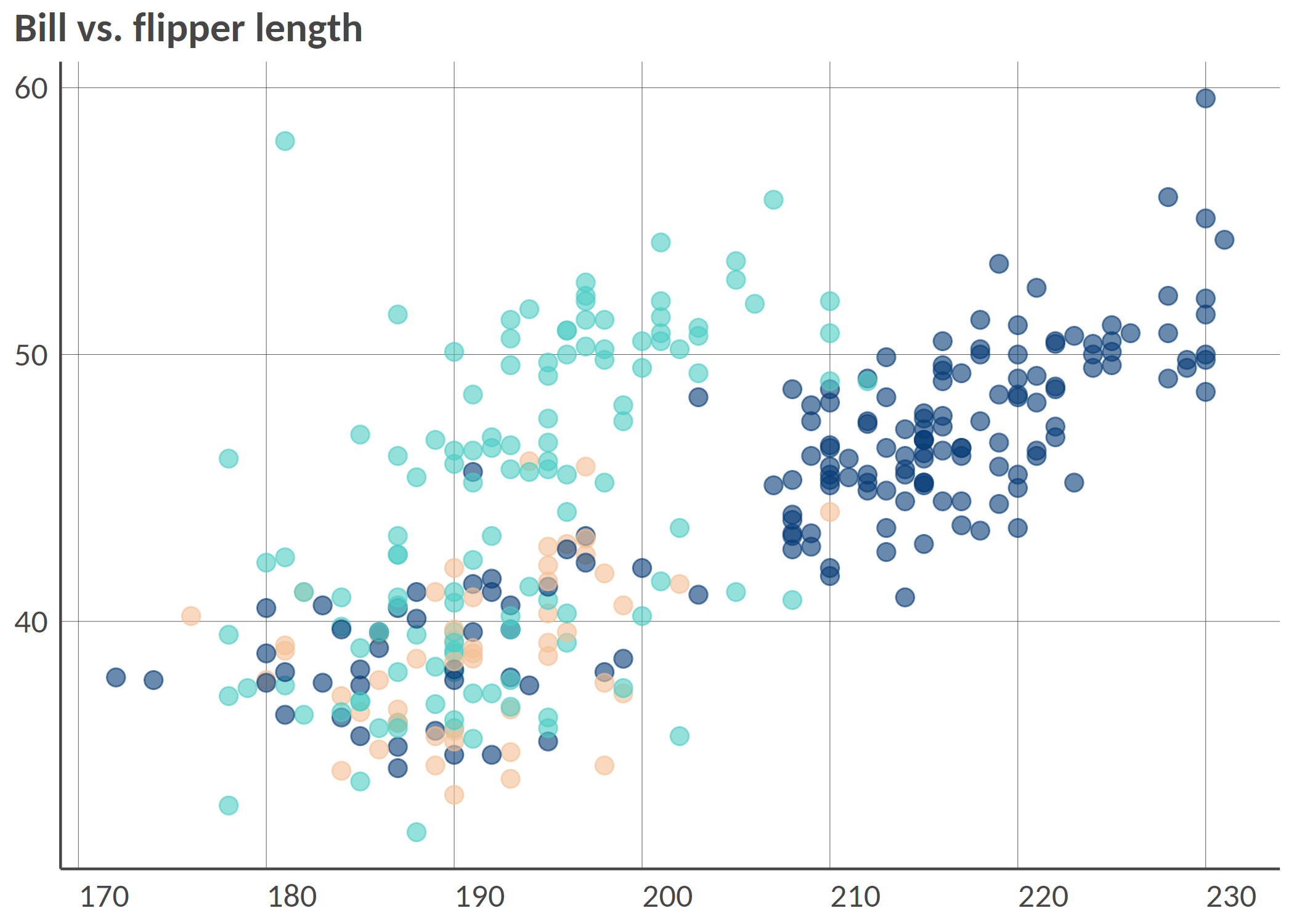
# Scatterplot with grouping colors, greater dot size, some transparency
point(penguins, "bill_length_mm", "flipper_length_mm", "island", group_title = "Island", alpha = 0.6, size = 3, title = "Bill vs. flipper length", , add_color_guide = FALSE)
```
``` r
# Scatterplot with grouping colors, greater dot size, some transparency
point(penguins, "bill_length_mm", "flipper_length_mm", "island", group_title = "Island", alpha = 0.6, size = 3, title = "Bill vs. flipper length", , add_color_guide = FALSE)
```
 ``` r
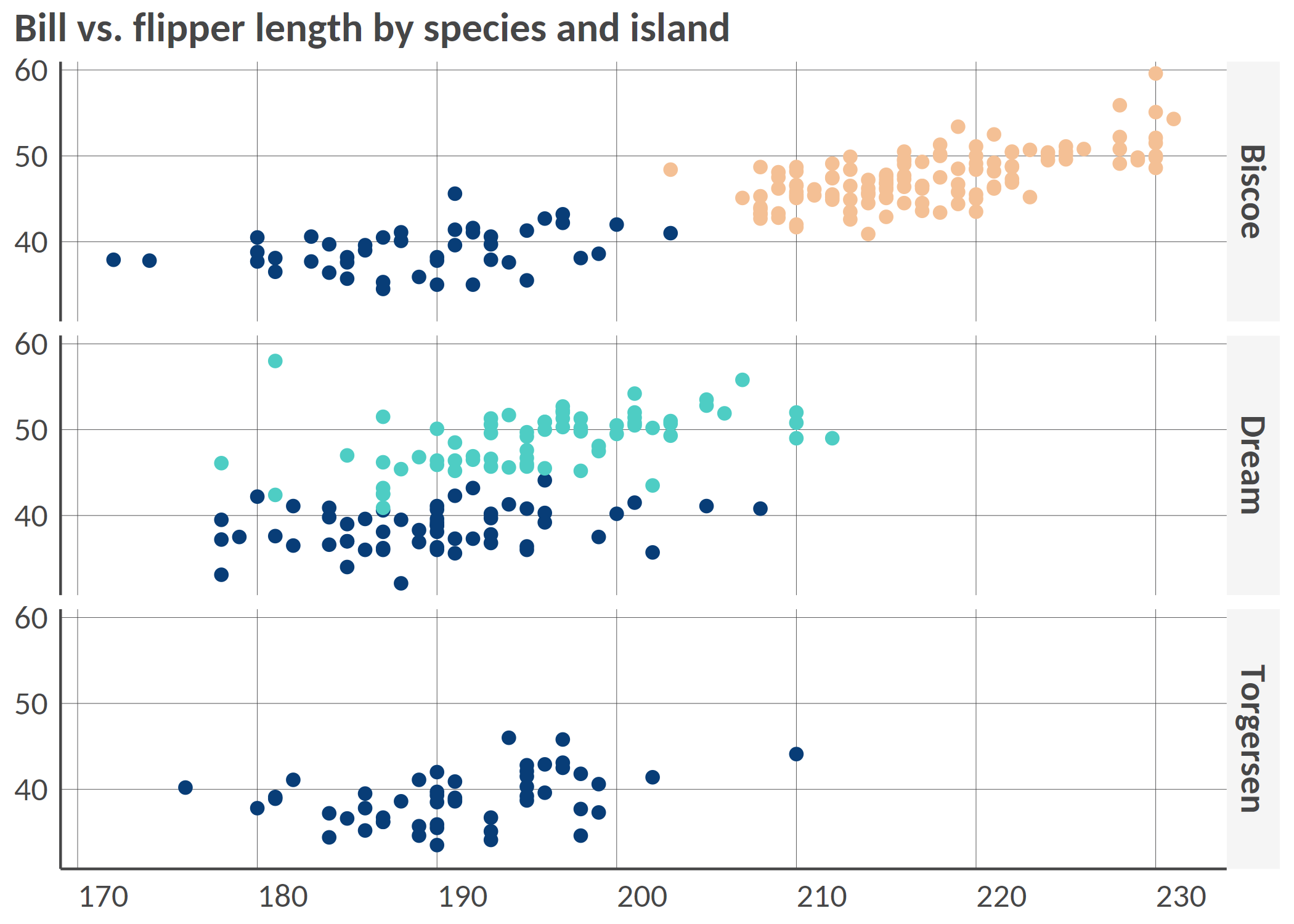
# Facetted scatterplot by island
point(penguins, "bill_length_mm", "flipper_length_mm", "species", "island", "fixed", group_title = "Species", title = "Bill vs. flipper length by species and island", add_color_guide = FALSE)
```
``` r
# Facetted scatterplot by island
point(penguins, "bill_length_mm", "flipper_length_mm", "species", "island", "fixed", group_title = "Species", title = "Bill vs. flipper length by species and island", add_color_guide = FALSE)
```
 ### Example 3: Dumbbell plot
Remember to ensure that your data are in the long format and you only
have two groups on the x-axis; for instance, IDP and returnee and no NA
values.
``` r
# Prepare long data
df <- tibble::tibble(
admin1 = rep(letters[1:8], 2),
setting = c(rep(c("Rural", "Urban"), 4), rep(c("Urban", "Rural"), 4)),
stat = rnorm(16, mean = 50, sd = 18)
) |>
dplyr::mutate(stat = round(stat, 0))
# dumbbell(
# df,
# "stat",
# "setting",
# "admin1",
# title = "% of HHs that reported open defecation as sanitation facility",
# group_y_title = "Admin 1",
# group_x_title = "Setting"
# )
```
### Example 4: donut chart
``` r
# Some summarized data: % of HHs by displacement status
df <- tibble::tibble(
status = c("Displaced", "Non displaced", "Returnee", "Don't know/Prefer not to say"),
percentage = c(18, 65, 12, 3)
)
# Donut
# donut(df,
# status,
# percentage,
# hole_size = 3,
# add_text_suffix = "%",
# add_text_color = color("dark_grey"),
# add_text_treshold_display = 5,
# x_title = "Displacement status",
# title = "% of HHs by displacement status"
# )
```
### Example 5: Waffle chart
``` r
#
# waffle(df, status, percentage, x_title = "A caption", title = "A title", subtitle = "A subtitle")
```
### Example 6: Alluvial chart
``` r
# Some summarized data: % of HHs by self-reported status of displacement in 2021 and in 2022
df <- tibble::tibble(
status_from = c(
rep("Displaced", 4),
rep("Non displaced", 4),
rep("Returnee", 4),
rep("Dnk/Pnts", 4)
),
status_to = c("Displaced", "Non displaced", "Returnee", "Dnk/Pnts", "Displaced", "Non displaced", "Returnee", "Dnk/Pnts", "Displaced", "Non displaced", "Returnee", "Dnk/Pnts", "Displaced", "Non displaced", "Returnee", "Dnk/Pnts"),
percentage = c(20, 8, 18, 1, 12, 21, 0, 2, 0, 3, 12, 1, 0, 0, 1, 1)
)
# Alluvial, here the group is the status for 2021
# alluvial(df,
# status_from,
# status_to,
# percentage,
# status_from,
# from_levels = c("Displaced", "Non displaced", "Returnee", "Dnk/Pnts"),
# alpha = 0.8,
# group_title = "Status for 2021",
# title = "% of HHs by self-reported status from 2021 to 2022"
# )
```
### Example 7: Lollipop chart
``` r
library(tidyr)
# Prepare long data
df <- tibble::tibble(
admin1 = replicate(15, sample(letters, 8)) |> t() |> as.data.frame() |> unite("admin1", sep = "") |> dplyr::pull(admin1),
stat = rnorm(15, mean = 50, sd = 15)
) |>
dplyr::mutate(stat = round(stat, 0))
# Make lollipop plot, vertical with 45 degrees angle X-labels
# lollipop(df,
# admin1,
# stat,
# arrange = FALSE,
# add_text = FALSE,
# flip = FALSE,
# y_title = "% of HHs",
# x_title = "Admin 1",
# title = "% of HHs that reported having received a humanitarian assistance"
# )
```
### Example 3: Dumbbell plot
Remember to ensure that your data are in the long format and you only
have two groups on the x-axis; for instance, IDP and returnee and no NA
values.
``` r
# Prepare long data
df <- tibble::tibble(
admin1 = rep(letters[1:8], 2),
setting = c(rep(c("Rural", "Urban"), 4), rep(c("Urban", "Rural"), 4)),
stat = rnorm(16, mean = 50, sd = 18)
) |>
dplyr::mutate(stat = round(stat, 0))
# dumbbell(
# df,
# "stat",
# "setting",
# "admin1",
# title = "% of HHs that reported open defecation as sanitation facility",
# group_y_title = "Admin 1",
# group_x_title = "Setting"
# )
```
### Example 4: donut chart
``` r
# Some summarized data: % of HHs by displacement status
df <- tibble::tibble(
status = c("Displaced", "Non displaced", "Returnee", "Don't know/Prefer not to say"),
percentage = c(18, 65, 12, 3)
)
# Donut
# donut(df,
# status,
# percentage,
# hole_size = 3,
# add_text_suffix = "%",
# add_text_color = color("dark_grey"),
# add_text_treshold_display = 5,
# x_title = "Displacement status",
# title = "% of HHs by displacement status"
# )
```
### Example 5: Waffle chart
``` r
#
# waffle(df, status, percentage, x_title = "A caption", title = "A title", subtitle = "A subtitle")
```
### Example 6: Alluvial chart
``` r
# Some summarized data: % of HHs by self-reported status of displacement in 2021 and in 2022
df <- tibble::tibble(
status_from = c(
rep("Displaced", 4),
rep("Non displaced", 4),
rep("Returnee", 4),
rep("Dnk/Pnts", 4)
),
status_to = c("Displaced", "Non displaced", "Returnee", "Dnk/Pnts", "Displaced", "Non displaced", "Returnee", "Dnk/Pnts", "Displaced", "Non displaced", "Returnee", "Dnk/Pnts", "Displaced", "Non displaced", "Returnee", "Dnk/Pnts"),
percentage = c(20, 8, 18, 1, 12, 21, 0, 2, 0, 3, 12, 1, 0, 0, 1, 1)
)
# Alluvial, here the group is the status for 2021
# alluvial(df,
# status_from,
# status_to,
# percentage,
# status_from,
# from_levels = c("Displaced", "Non displaced", "Returnee", "Dnk/Pnts"),
# alpha = 0.8,
# group_title = "Status for 2021",
# title = "% of HHs by self-reported status from 2021 to 2022"
# )
```
### Example 7: Lollipop chart
``` r
library(tidyr)
# Prepare long data
df <- tibble::tibble(
admin1 = replicate(15, sample(letters, 8)) |> t() |> as.data.frame() |> unite("admin1", sep = "") |> dplyr::pull(admin1),
stat = rnorm(15, mean = 50, sd = 15)
) |>
dplyr::mutate(stat = round(stat, 0))
# Make lollipop plot, vertical with 45 degrees angle X-labels
# lollipop(df,
# admin1,
# stat,
# arrange = FALSE,
# add_text = FALSE,
# flip = FALSE,
# y_title = "% of HHs",
# x_title = "Admin 1",
# title = "% of HHs that reported having received a humanitarian assistance"
# )
```